→Why Nikhil Kamath’s First Home Purchase Signals a Shift in India’s Real Estate Conversation
For years, the debate between buying and renting property has dominated dinner table conversations, financial planning sessions, and boardroom discussions across India.
It’s a decision that impacts not just our wallets, but our lifestyles, careers, and long-term financial security.
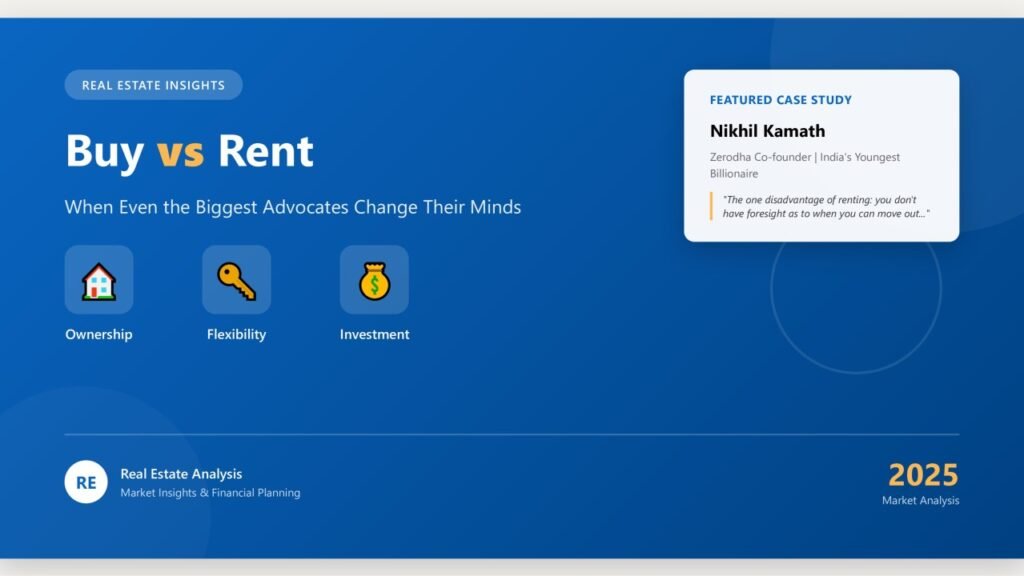
Recently, this debate gained renewed attention when Zerodha co-founder Nikhil Kamath—one of India’s most vocal advocates for renting—announced on his podcast “WTF is with Nikhil Kamath” that he had purchased his first home in October 2024.
The irony wasn’t lost on anyone. Here was a billionaire who had championed the flexibility and financial advantages of renting, finally joining the homeowner’s club.
But this isn’t a story of hypocrisy. It’s a masterclass in understanding that the buy vs rent decision isn’t black and white—it’s deeply personal, context-dependent, and evolves with life circumstances.
✔️The Nikhil Kamath Story: A Case Study in Changing Perspectives For those unfamiliar with Kamath’s previous stance, he had been a strong advocate of renting over buying. His former residence—a sprawling 7,000-square-foot apartment in Bengaluru’s prestigious Kingfisher Towers, reportedly worth ₹40-50 crore—was rented, not owned.
🔹His logic was sound: why lock up capital in an illiquid asset when you could invest it elsewhere for better returns? Yet, in his podcast discussion with real estate heavyweights Irfan Razack (Chairman & MD of Prestige Group), Nirupa Shankar (Executive Director at Brigade Group), and Karan Virwani (CEO of WeWork India), Kamath revealed the one disadvantage of renting that finally pushed him to buy: “The thing with renting, of all the advantages of renting, there is one disadvantage: you don’t have foresight as to when you can move out of the house. I had to move out of this house, whereas I might have liked to stay longer in this house.”
This lack of control—the fundamental uncertainty about tenure—proved to be the tipping point. Even with all the financial flexibility that renting provided, the inability to decide your own future in a space you call home became too significant to ignore.
Kamath still expressed his displeasure with real estate’s illiquidity and the hefty stamp duties (5-6% of property value) that governments levy. He noted that in the stock market, he can buy and sell without such charges. But ultimately, the personal need for stability outweighed the financial calculations.
✔️The 2025 Reality: What the Numbers Tell Us The Indian real estate market in 2025 presents a fascinating picture. According to recent research, the answer to “should you buy or rent?” varies dramatically by city:
Cities Where Buying Makes Sense (Breakeven: 3-8 years) – Bengaluru – Hyderabad – Pune
Cities Where Renting Still Wins (Breakeven: 30+ years) – Mumbai – Delhi
🔹The study factored in all costs—down payments, stamp duty, EMIs, maintenance for buyers, and rent, deposits, opportunity cost of capital for renters. The “breakeven point” represents when the financial gains from buying (property appreciation minus costs) overtake the wealth accumulated from renting and investing the difference.
✔️The Market Dynamics Property prices across India saw a 10% year-on-year increase in Q1 2024. Meanwhile, rental prices have surged 30% in many metropolitan areas post-pandemic. This simultaneous rise has made the decision even more complex:
🔹Mumbai: Median monthly rents in premium locations have crossed ₹1,00,000
🔹Bengaluru: Residential demand grew 18.2% quarter-on-quarter in Q3 2024
🔹 Delhi NCR: Rental values increased 15-20% year-on-year
✔️The Key Decision Criteria: Beyond the Numbers While financial metrics are important, the buy vs rent decision hinges on several interconnected factors:
🔹Time Horizon: The 5-Year Rule If you plan to stay in a location for less than 3-5 years, renting typically makes more financial sense. The upfront costs of buying (down payment, stamp duty, registration fees) and exit costs (brokerage, capital gains tax if sold within 2 years) eat into any potential appreciation. However, if you’re settling down for 7-10 years or more, buying allows you to build equity and potentially benefit from property appreciation.
🔹 Financial Position: The 30-40% Principle Financial experts recommend having at least 30-40% of the property value as a down payment before considering purchase.
With banks typically financing up to 80% of the property value, this leaves a 20% down payment plus an additional 10-20% cushion for stamp duty, registration, and other costs. Additionally, your monthly EMI (including principal and interest) should not exceed 30% of your monthly income to maintain financial stability.
🔹 Career Flexibility vs. Stability Renting provides unmatched mobility—crucial for professionals in dynamic industries or those early in their careers. Young professionals, gig workers, and those in jobs requiring frequent relocation benefit from this flexibility.
Conversely, established professionals in stable careers with clear long-term location plans find homeownership more aligned with their lifestyle.
🔹Opportunity Cost: Where Could Your Money Work Harder? This is where Kamath’s original logic came in. The money tied up in a down payment and EMIs could alternatively be invested in: – Diversified equity portfolios (potentially 10-12% annual returns) – Mutual funds – Business expansion – Other higher-liquidity assets However, real estate offers something these don’t: forced savings through EMI payments and a tangible hedge against inflation. Your monthly payment remains fixed (for fixed-rate mortgages) while rents keep rising.
🔹Tax Benefits: The Hidden Advantage Homeowners in India can avail significant tax deductions: – Up to ₹2 lakh on home loan interest (Section 24(b)) – Up to ₹1.5 lakh on principal repayment (Section 80C) – Additional deductions for first-time homebuyers These benefits can significantly reduce the effective cost of ownership, something renters miss out on entirely.
🔹 Psychological and Emotional Factors For many Indians, homeownership represents: – A major life milestone – Financial security – Social status – Legacy for children – Freedom to customize and personalize space These intangible benefits can’t be captured in spreadsheets but are very real to those who value them.
🔹 Local Market Dynamics: The Price-to-Rent Ratio A simple calculation can guide your decision: – Take the annual rent and divide it by the property price – If the ratio is below 3-4%, buying might make sense – If it’s above 5-6%, renting is likely better For example: – Property price: ₹1 crore – Annual rent: ₹3 lakh – Ratio: 3% (indicates buying might be favorable) But in Mumbai or South Delhi, this ratio often exceeds 5-6%, making renting more sensible.
✔️The Smart Approach: Making Your Decision Rather than following blanket advice or trends, consider these steps:
1. Assess Your Personal Situation – How long do you plan to stay in this city? – Is your income stable and growing? – Do you have sufficient savings for down payment + emergency fund? – What’s your risk tolerance?
2. Run the Numbers – Calculate total cost of ownership (not just EMI) – Factor in opportunity cost of capital – Consider tax benefits – Compare with rent + investment scenario
3. Evaluate the Market – Research property appreciation trends in your target area – Understand rental yield percentages – Check infrastructure development plans – Assess supply-demand dynamics
4. Consider Your Life Stage – Starting career: Rent for flexibility – Established career + family: Buy for stability – Pre-retirement: Depends on future plans 5. Don’t Ignore Your Gut – How important is having “your own space”? – Can you handle maintenance responsibilities? – Do you want the freedom to customize? – What gives you peace of mind?
🔹The Bengaluru Advantage: A Special Case It’s worth noting that Kamath bought in Bengaluru, not Mumbai or Delhi. This choice aligns with the data. Bengaluru offers: – Relatively moderate property prices compared to Mumbai/Delhi – Strong rental yields – Quick breakeven (3-5 years) – Consistent appreciation driven by tech sector growth – Excellent infrastructure development For someone planning to stay in Bengaluru long-term, buying makes compelling financial sense—even for someone like Kamath who can easily afford to rent the most luxurious properties.
✔️Lessons from Kamath’s Decision Kamath’s home purchase teaches us several valuable lessons: 1. Life Circumstances Change: What works at one stage of life may not work at another. Being dogmatic about renting or buying is shortsighted.
2. Control Matters: Financial optimization isn’t everything. The peace of mind and control that comes with ownership has real value.
3. Context is King: Kamath bought in a city where the numbers make sense (Bengaluru) rather than one where they don’t (Mumbai/Delhi).
4. It’s Okay to Change Your Mind: As more information becomes available and circumstances evolve, adapting your strategy isn’t hypocrisy—it’s wisdom.
5. Personal Factors Trump Pure Economics: Even billionaires value stability and control over their living situation.
✔️The Verdict: There Is No Universal Answer The truth is, there’s no one-size-fits-all answer to the buy vs rent debate. It depends on: – Your city – Your financial position – Your career stage – Your personal values – Your life plans – Market conditions In 2025, with property prices at record highs but rental yields also increasing, the decision is more nuanced than ever.
🔹You should consider buying if: – You plan to stay in one place for 7+ years – You have 30-40% of property value as down payment – Your career is stable with predictable income – The price-to-rent ratio is favorable – You value stability and customization
🔹You should consider renting if: – You might relocate within 3-5 years – You don’t have sufficient savings for down payment – You prefer investing in higher-return assets – You value mobility and flexibility – The price-to-rent ratio heavily favors renting
Final Thoughts Nikhil Kamath’s journey from renting advocate to homeowner isn’t a contradiction—it’s an evolution. It reflects the reality that financial decisions aren’t made in a vacuum. They’re shaped by life stages, market conditions, personal priorities, and circumstances.
✔️The key takeaway? Don’t let others’ opinions—or even your own past opinions—dictate your decision. Run the numbers, understand the market, assess your situation, and make the choice that aligns with your unique circumstances and values. Whether you choose to rent or buy, the most important thing is that you make an informed decision that supports your financial goals and gives you peace of mind.
After all, a home isn’t just about the bricks and mortar—it’s about creating a foundation for the life you want to build.
What’s your take on the buy vs rent debate? Have your views evolved over time like Nikhil Kamath’s? Share your thoughts in the comments below. #RealEstate #PersonalFinance #Investment #PropertyInvestment #BuyVsRent #NikhilKamath #Zerodha #FinancialPlanning #IndianRealEstate #WealthCreation