✔️Executive Summary
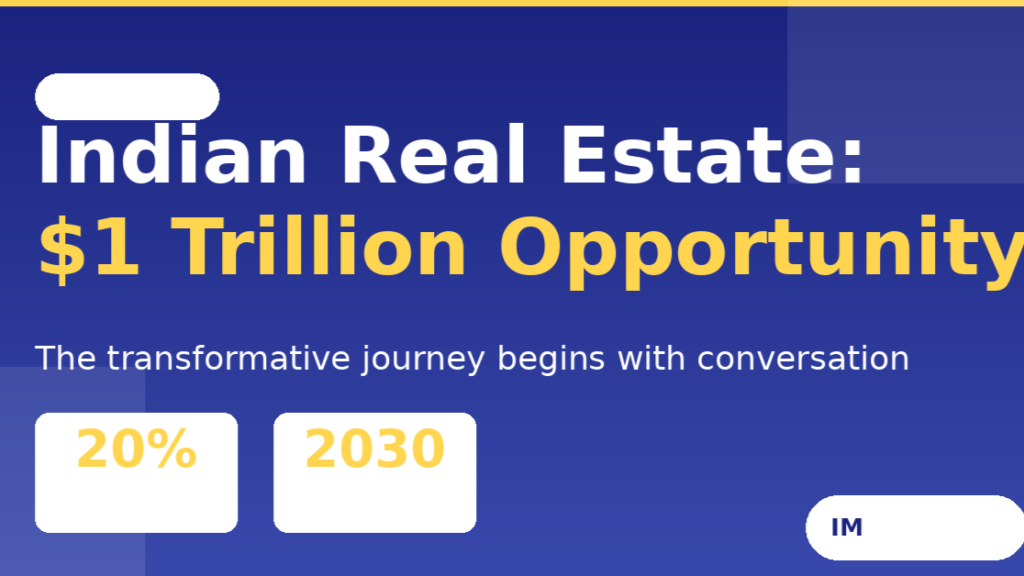
The Indian Real Estate sector stands at a pivotal juncture, poised to contribute 20% to the nation’s GDP by 2030, reaching a valuation of $1 trillion. This unprecedented growth trajectory necessitates enhanced dialogue and collaboration among all stakeholders in this evolving ecosystem. As the sector transitions from traditional practices to a modern, technology-driven, and regulation-compliant industry, meaningful conversations between developers, policymakers, investors, consumers, and other key players become not just beneficial, but essential.
✔️The Magnitude of Transformation
Current Landscape vs. 2030 Vision
The Indian Real Estate sector is experiencing its most significant transformation since independence. From being largely unorganized and fragmented, the industry is evolving into a professionally managed, transparent, and institutionally backed powerhouse. The projected $1 trillion valuation represents more than just numbers—it signifies a fundamental shift in how real estate operates in India.
Key Growth Drivers:
• Urbanization: By 2030, nearly 40% of India’s population will reside in urban areas, creating unprecedented demand for residential, commercial, and infrastructure development
• Economic Growth: India’s GDP is expected to reach $7-8 trillion by 2030, with real estate being both a contributor and beneficiary
• Demographic Dividend: A young, aspirational population seeking quality housing and workspaces
• Infrastructure Development: Government initiatives like Smart Cities, AMRUT, and the National Infrastructure Pipeline
• Foreign Investment: Increased FDI limits and regulatory clarity attracting global capital
The 20% GDP Contribution: What It Means
When real estate contributes 20% to GDP, it signifies:
• Employment Generation: The sector will directly and indirectly employ over 70 million people
• Multiplier Effect: Real estate impacts 250+ ancillary industries, from cement and steel to furniture and electronics
• Wealth Creation: Massive asset creation for individuals, institutions, and the nation
• Economic Stability: Real estate as a cornerstone of financial security and investment
✔️Why Stakeholder Conversations Are Critical
The Complexity of Modern Real Estate
Today’s real estate ecosystem is vastly more complex than a decade ago. The introduction of RERA, GST, PMAY, and various state-level regulations has created a multi-layered framework requiring constant dialogue and alignment.
✔️Key Stakeholder Groups
1. Developers and Builders
• Traditional family-run businesses transitioning to corporate structures
• Need for capital-efficient, sustainable development models
• Balancing profitability with regulatory compliance and customer satisfaction
2. Government and Regulatory Bodies
• Central and state governments
• RERA authorities
• Urban planning commissions
• Environmental regulatory bodies
3. Financial Institutions
• Banks and NBFCs providing construction and home finance
• REITs and InvITs channeling institutional capital
• Private equity and venture capital funds
4. Customers and End-Users
• Homebuyers seeking transparency and timely delivery
• Commercial tenants requiring flexible, technology-enabled spaces
• NRIs investing in Indian real estate
5. Technology and Service Providers
• PropTech companies revolutionizing the sector
• Architecture and design firms
• Construction technology providers
• Facility management companies
6. Industry Associations and Think Tanks
• CREDAI, NAREDCO, and regional associations
• Research institutions studying market trends
• Sustainability and green building councils
✔️Key Conversation Areas for Transformation
1. Regulatory Harmonization and Implementation
The Need:
While RERA has brought transparency, implementation varies across states. Conversations must focus on:
• Standardizing RERA implementation across India
• Simplifying approval processes and single-window clearances
• Balancing regulation with ease of doing business
• Creating a uniform taxation framework post-GST
Stakeholders Involved: Government bodies, developers, legal experts, consumer groups
2. Sustainable and Green Development
The Need:
With India’s commitment to net-zero by 2070, real estate must lead the charge:
• Adopting green building certifications (IGBC, GRIHA, LEED)
• Integrating renewable energy in developments
• Water conservation and waste management
• Carbon-neutral construction practices
Stakeholders Involved: Developers, environmental agencies, technology providers, certification bodies
3. Affordable Housing and Inclusive Growth
The Need:
Ensuring the $1 trillion growth benefits all sections of society:
• Scaling up PMAY and similar initiatives
• Innovative financing models for low-income segments
• Public-private partnerships for mass housing
• Rental housing policy and framework
Stakeholders Involved: Government, developers, financial institutions, NGOs, urban planners
4. Technology Integration and Digital Transformation
The Need:
Embracing PropTech and ConTech for efficiency and transparency:
• AI and IoT in property management
• Blockchain for property records and transactions
• Virtual reality for property viewing and marketing
• Construction automation and modular building techniques
• Data analytics for market intelligence
Stakeholders Involved: Developers, technology companies, investors, customers
5. Capital Formation and Alternative Investment Structures
The Need:
Meeting the massive capital requirement for $1 trillion sector:
• Deepening the REIT and InvIT markets
• Attracting long-term institutional capital
• Creating exit mechanisms for investors
• Developing secondary markets for real estate assets
• Crowdfunding and fractional ownership models
Stakeholders Involved: Developers, financial institutions, SEBI, investors, fund managers
6. Urban Planning and Infrastructure Integration
The Need:
Ensuring developments complement city growth:
• Transit-oriented development
• Mixed-use developments reducing commute needs
• Integration with metro, roads, and utilities
• Preservation of heritage and open spaces
• Disaster-resilient infrastructure
Stakeholders Involved: Urban planners, government, developers, architects, citizens
7. Workforce Skilling and Professional Development
The Need:
Building capabilities for a modern real estate sector:
• Formal education in real estate management
• Skilling construction workforce in new technologies
• Leadership development for next-generation developers
• Professional certifications and continuing education
Stakeholders Involved: Educational institutions, industry associations, developers, government
8. Consumer Protection and Market Transparency
The Need:
Building trust essential for sustained growth:
• Strengthening RERA compliance and enforcement
• Standardizing project disclosures
• Fair marketing and sales practices
• Efficient grievance redressal mechanisms
• Third-party quality audits
Stakeholders Involved: Consumer groups, RERA authorities, developers, legal experts
✔️Platforms for Meaningful Dialogue
🔹Industry Conferences and Summits
Regular national and regional conferences bringing together diverse stakeholders to discuss challenges, share best practices, and forge collaborations.
🔹Working Groups and Task Forces
Government-industry working groups on specific issues like:
• Streamlining approvals
• Standardizing construction quality
• Green building adoption
• Affordable housing delivery
🔹Public-Private Partnerships
Structured PPP frameworks for:
• Infrastructure development
• Affordable housing projects
• Smart city initiatives
• Slum rehabilitation
🔹Digital Platforms and Communities
Online forums, webinars, and digital communities enabling continuous conversation beyond physical events.
🔹Research and White Papers
Collaborative research between industry, academia, and government producing actionable insights and policy recommendations.
✔️Challenges Requiring Collective Action
1. Land Acquisition and Titling
• Complex land ownership records
• Lengthy acquisition processes
• Title disputes and litigation
• Need for digital land records
2. Construction Cost Escalation
• Rising material and labor costs
• Supply chain uncertainties
• Impact on project viability and affordability
• Need for innovative cost management
3. Environmental and Social Concerns
• Balancing development with environmental protection
• Rehabilitation and resettlement challenges
• Community engagement and acceptance
• Sustainable resource utilization
4. Market Cycles and Risk Management
• Managing boom-bust cycles
• Project financing during downturns
• Inventory management
• Diversification strategies
5. Quality and Safety Standards
• Ensuring construction quality
• Occupational safety for workers
• Structural safety and disaster resilience
• Standardization across the industry
✔️The Path Forward: A Collaborative Vision
🔹Short-term Actions (2024-2026)
Regulatory:
• Complete RERA implementation across all states
• Launch single-window clearance systems in major cities
• Harmonize state-level stamp duties and charges
Industry:
• Adopt common quality and disclosure standards
• Increase green building certifications
• Strengthen industry self-regulation
Financial:
• Expand REIT listings and investment options
• Improve access to construction finance
• Develop risk mitigation instruments
Social:
• Increase affordable housing delivery
• Improve construction worker welfare
• Enhance customer education and protection
✔️Medium-term Goals (2026-2028)
Technology:
• Widespread adoption of PropTech across the value chain
• AI-driven project planning and execution
• Digital property records and transactions
Sustainability:
• Achieve 50% of new construction with green certifications
• Integrate renewable energy in all new projects
• Establish circular economy practices in construction
Market Development:
• Create vibrant secondary markets for properties
• Develop rental housing at scale
• Expand co-living and co-working segments
Capacity Building:
• Establish real estate universities and training centers
• Certify 1 million construction workers in modern techniques
• Develop 10,000 professional real estate managers
✔️Long-term Vision (2028-2030)
🔹Achieving the $1 Trillion Milestone:
• World-class infrastructure and quality standards
• Complete transparency and digitalization
• Carbon-neutral development becoming the norm
• Indian real estate attracting global recognition
Beyond 2030:
• Position India as a global real estate hub
• Export Indian real estate expertise and models
• Lead in sustainable and affordable development globally
• Integrate seamlessly with India’s $10 trillion economy vision
✔️Conclusion: The Imperative of Dialogue
The journey to a $1 trillion real estate sector contributing 20% to India’s GDP is not predetermined—it requires conscious effort, collaboration, and continuous adaptation. The transformative phase we’re experiencing is characterized by:
• Unprecedented Opportunity: The scale of growth offers life-changing opportunities for millions
• Complex Challenges: No single stakeholder can address the multifaceted challenges alone
• Rapid Evolution: Technology, regulation, and consumer expectations are evolving faster than ever
• Global Context: India’s real estate must compete and collaborate globally
Meaningful conversations between stakeholders are not optional—they are the foundation upon which this transformation will be built. These dialogues must be:
• Inclusive: Involving all stakeholders, especially consumers and workers often left out of policy discussions
• Action-oriented: Moving beyond talk to concrete commitments and implementations
• Continuous: Not limited to annual conferences but ongoing through multiple platforms
• Transparent: Sharing information, challenges, and learnings openly
• Forward-looking: Anticipating future trends rather than merely reacting to current issues
🔹For industry leaders and peers, this is a moment to step up—not just as builders of structures, but as architects of an industry that serves the nation’s aspirations. The conversations we have today will determine whether we merely reach the $1 trillion milestone or exceed it while creating sustainable, inclusive, and world-class built environments.
🔹The future of Indian Real Estate is being written now. Every stakeholder has a role in this narrative. The question is: Are we ready to engage in the conversations that will shape this extraordinary transformation?
🌍The time for dialogue is now. The opportunity is unprecedented. The responsibility is collective.