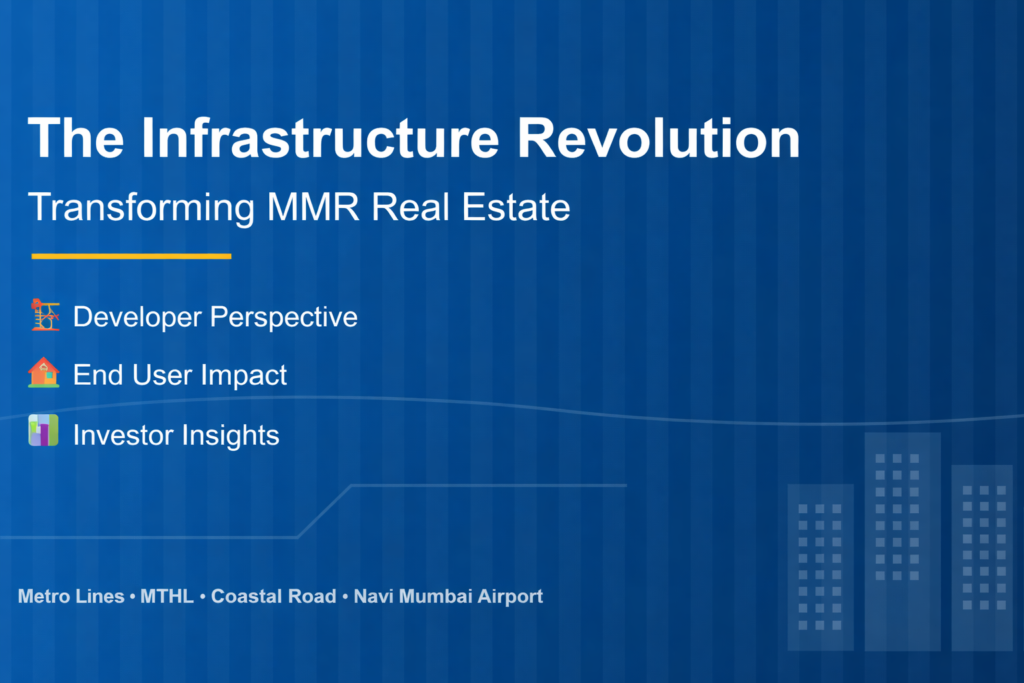
The Infrastructure Revolution: Transforming Mumbai Metropolitan Region’s Real Estate Landscape
The Mumbai Metropolitan Region (MMR) is witnessing an unprecedented infrastructure boom that’s fundamentally reshaping its real estate dynamics. From the operational Mumbai Metro lines to the ambitious Mumbai Trans Harbour Link and Coastal Road, these developments are creating ripple effects across the property market. Let’s examine how these transformations are impacting three key stakeholder groups.
From the Real Estate Developer’s Lens
Infrastructure projects have become the invisible hand guiding our development decisions and strategy formulation.
Completed Projects: Unlocking New Micro-markets
The operational Metro corridors—particularly Line 2A (Dahisar-DN Nagar) and Line 7 (Dahisar East-Andheri East)—have fundamentally altered land valuations. We’re witnessing 25-40% appreciation in catchment areas within 500 meters of metro stations. This has enabled developers to command premium pricing while maintaining absorption rates.
The Eastern Freeway’s completion reduced travel time from South Mumbai to the eastern suburbs by nearly 45 minutes, making previously overlooked locations like Chembur and Ghatkopar viable for premium residential developments. We’re now launching projects in these micro-markets that would have been commercially unviable five years ago.
Ongoing Projects: Strategic Land Banking and Phasing
The Mumbai Trans Harbour Link (MTHL) and Navi Mumbai International Airport are game-changers for Navi Mumbai and the extended MMR. We’re strategically acquiring land banks in Panvel, Kharghar, and Ulwe—areas that will witness explosive growth post-completion. The challenge lies in phasing launches to align with infrastructure completion timelines while managing holding costs.
The Coastal Road project is reshaping Western suburbs’ desirability. We’re repositioning existing inventory in Bandra, Worli, and surrounding areas, anticipating connectivity premiums of 30-50% upon completion.
Challenges We Navigate
Timeline uncertainties remain our biggest risk. Project delays can lock up capital and misalign our launch schedules. We’ve learned to build 12-18 month buffer periods into our feasibility analyses. Additionally, the RERA regime demands that we cannot pre-sell based solely on infrastructure promises—we need tangible progress before marketing connectivity as a USP.
The End User’s Perspective
For homebuyers and tenants, infrastructure is redefining the work-life equation and investment logic.
Completed Infrastructure: Expanding the Radius of Possibility
The operational Metro network has been liberating. Professionals working in BKC can now comfortably live in Ghatkopar or Andheri East, enjoying 30-40% lower property prices without sacrificing connectivity. The daily commute that once meant two hours in traffic now takes 35 minutes by Metro.
This has democratized access to quality housing. Young professionals and growing families are no longer forced to choose between proximity and space. A 2BHK in Dahisar offers better value and livability than a cramped 1BHK in Lower Parel, thanks to Metro Line 7.
Ongoing Projects: Future-Proofing Decisions
The anticipation of MTHL and Navi Mumbai Airport is driving migration to Navi Mumbai. End users are making calculated bets—purchasing properties at current rates (often 40-50% cheaper than Mumbai proper) with confidence that connectivity will bridge the gap within 2-3 years.
The Coastal Road project is particularly exciting for those working in South Mumbai. The promise of reaching Nariman Point from Bandra in 20 minutes versus the current 60-90 minutes is compelling enough to justify current purchases in anticipation of future convenience.
The Calculus of Timing
The dilemma for end users is timing the market. Buy now in emerging corridors and enjoy lower prices but endure temporary inconvenience? Or wait for infrastructure completion and pay the premium? Most savvy buyers we interact with are choosing the former, viewing 2-3 years of adjustment as a worthwhile trade-off for long-term appreciation and better quality of life.
Through the Investor’s Prism
Infrastructure projects represent both opportunity and complexity for individual and institutional investors.
Individual Investors: The Infrastructure Arbitrage
Retail investors have learned to track infrastructure announcements with the diligence once reserved for stock markets. The pattern is consistent: announcements trigger 10-15% immediate appreciation, completion drives another 25-35% over 3-5 years.
Smart individual investors are focusing on:
- Station proximity plays: Properties within 500m radius of upcoming Metro stations in areas like Jogeshwari, Goregaon, and Malad
- Corridor bets: Stretches along the Coastal Road and MTHL catchment areas
- Last-mile connectivity: Areas where Metro+ feeder infrastructure creates comprehensive connectivity solutions
The rental yield equation is also improving. Metro-connected properties in Andheri East and Ghatkopar are commanding 15-20% rental premiums while maintaining high occupancy rates of 90%+, pushing gross yields to attractive 3-3.5% levels.
Institutional Investors: Portfolio Recalibration
For institutional players—REITs, AIFs, and PE funds—infrastructure is driving fundamental portfolio rebalancing. We’re seeing capital rotation from saturated micro-markets toward infrastructure-led emerging zones.
The Grade-A office space story is particularly compelling. BKC and Lower Parel dominated the past decade, but institutional money is now flowing to Navi Mumbai, anticipating the airport’s multiplier effect on commercial real estate. Pre-leased assets along Metro corridors are finding ready buyers at compressed cap rates (7.5-8.5%), reflecting confidence in long-term value accretion.
Risk-Adjusted Returns Framework
Institutional investors operate with sophisticated risk models. Infrastructure projects are assessed on:
- Completion probability: Government-backed projects score higher than PPP models with execution risks
- Economic impact magnitude: Airports and metro networks trump peripheral road projects
- Timeline clarity: Projects with clear milestones allow better capital deployment planning
The sweet spot for institutions is entering markets 12-18 months before infrastructure completion—late enough to have certainty, early enough to capture meaningful appreciation.
Warehousing and Logistics: The Institutional Dark Horse
A less-discussed opportunity is warehousing and industrial real estate. The Mumbai-Pune Expressway, MTHL, and Navi Mumbai Airport are creating a logistics corridor that institutional investors are aggressively targeting. Yields of 8-10% with long-term escalations make this asset class attractive for patient capital.
The Convergence: Where Interests Align
While each stakeholder group has distinct priorities, infrastructure projects create convergence zones where everyone wins.
Developers gain pricing power and can unlock new supply. End users access better connectivity and housing choices. Investors—both individual and institutional—find appreciation opportunities with improving fundamentals.
The operational Metro lines prove this thesis. Areas like Andheri East have simultaneously seen: new premium residential supply (developers), improved work-life balance for residents (end users), and 30%+ appreciation over three years (investors).
Looking Ahead: The Infrastructure Pipeline
The MMR’s infrastructure pipeline for 2025-2030 is robust: Metro Lines 4, 5, 6 (various stages), Virar-Alibaug Multimodal Corridor, and multiple road network expansions. Each project will catalyze specific micro-markets, creating waves of opportunity.
The challenge for all stakeholders is information asymmetry and timing. Those who can accurately predict completion timelines and assess genuine impact versus hype will extract maximum value.
Concluding Thoughts
Infrastructure is no longer just about physical connectivity—it’s the invisible architecture reshaping MMR’s real estate market. For developers, it’s determining where and what to build. For end users, it’s expanding choices and redefining quality of life. For investors, it’s creating systematic arbitrage opportunities.
The winners in this transformation will be those who view infrastructure not as isolated projects but as interconnected systems that fundamentally alter urban economics, accessibility, and desirability. The MMR’s real estate story for the next decade will be written along these infrastructure corridors.
What’s your perspective on infrastructure’s impact on MMR real estate? Are you bullish on emerging corridors or staying with established micro-markets? Share your thoughts in the comments.
#MumbaiRealEstate #Infrastructure #MMR #RealEstateInvesting #MumbaiMetro #PropertyMarket #RealEstateDevelopment #UrbanDevelopment #InfrastructureInvesting