Indian Family Offices Investing in Real Estate: Structured Investment Products
Market Overview
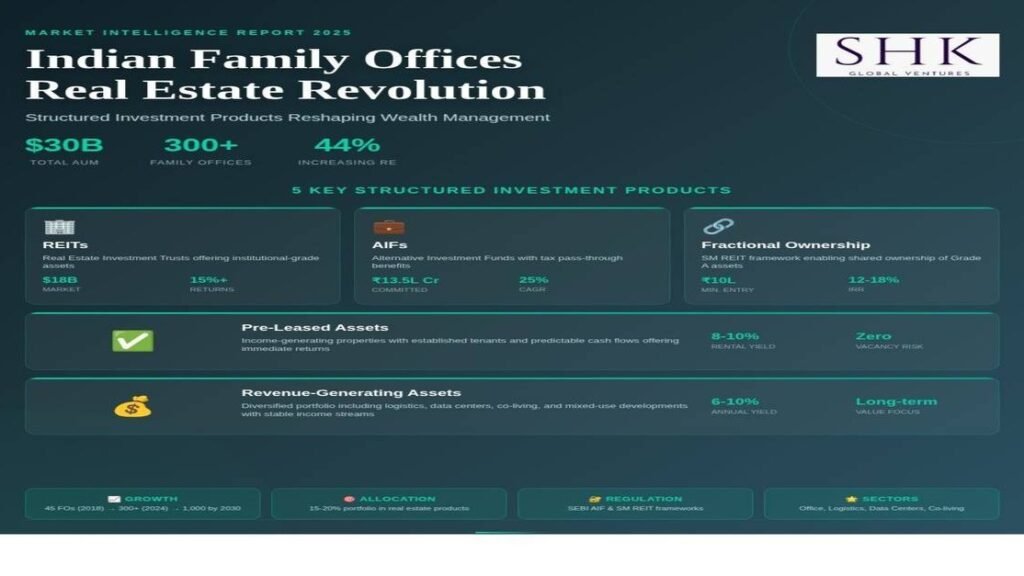
The Indian family office ecosystem has experienced remarkable growth, expanding from just 45 offices in 2018 to approximately 300 in 2024, collectively managing an estimated $30 billion in assets under management (AUM). This growth is projected to continue at a 16% annual rate, with the number expected to reach 1,000 family offices in the coming years.
According to the Knight Frank Wealth Report 2025, 44% of family offices plan to increase their real estate investments, demonstrating strong confidence in the real estate market’s long-term prospects. Real estate typically represents 15-20% of family office investment portfolios.
Key Investment Themes
Family offices are prioritizing:
- Income-generating assets with stable cash flows
- Sustainability-focused investments
- Transparency in operations
- Long-term value creation
- Legacy landmark projects
1. REITs (Real Estate Investment Trusts)
Market Development
India’s REIT market has grown significantly, reaching $18 billion since 2019, making it one of the fastest-growing REIT markets globally and expected to surpass $25 billion by 2029.
Available REITs in India
Currently, India has three office REITs and one retail REIT:
- Embassy Office Parks REIT – India’s first publicly listed REIT (offices in Bengaluru, Mumbai, Pune, NCR, Chennai)
- Mindspace Business Parks REIT – Office parks in Mumbai, Hyderabad, Pune, Chennai
- Nexus Select Trust – First retail-focused REIT with shopping malls across India
- Brookfield India Real Estate Trust – Office assets
Performance
In financial year 2024-2025, the three office REITs collectively garnered leasing volumes of more than 16 million sq ft, accounting for close to a fifth of the gross leasing volume across the top eight cities. India office REITs recorded over 15% capital appreciation in the last 12 months, outperforming the BSE Realty Index.
Key Features for Family Offices
- Professionally managed portfolios
- Regular dividend distributions (90% of taxable income)
- Liquidity through stock exchange trading
- Institutional-grade assets
- Regulatory oversight by SEBI
2. Alternative Investment Funds (AIFs)
Market Growth
As of March 2025, AIFs had received commitments exceeding ₹13.49 lakh crore, growing at a five-year CAGR of over 25%, making them one of the fastest-growing investment avenues for Indian high-net-worth individuals and family offices.
AIF Categories for Real Estate
Category I AIFs:
- Infrastructure funds
- Social venture funds
- Receive government incentives
- No leverage permitted
Category II AIFs:
- Real Estate Funds – Invest in commercial, residential, and mixed-use properties
- Private Equity Funds – Mid-stage business investments
- Credit Opportunities Funds – Structured debt against real estate projects
- Pre-IPO Funds – Late-stage business investments
- Minimum investment: ₹1 crore
Category III AIFs:
- Hedge funds employing complex strategies
- Can use leverage
- Listed market strategies
Real Estate AIF Examples
Major players offering real estate AIFs include:
- Sundaram Alternates (real estate credit funds)
- Edelweiss Alternatives (real estate credit, infrastructure)
- HDFC, Birla, Axis, Kotak (various real estate funds)
- IIFL (credit opportunities)
Benefits for Family Offices
AIFs are gaining traction among Indian family offices as a preferred tool for accessing private markets, with projected allocations increasing from current levels to 18% over the next three years.
- Tax pass-through at fund level for Category I and II AIFs
- Professional fund management expertise
- Diversified portfolios mitigating single-investment risks
- Access to institutional-quality deals
- Regulatory oversight by SEBI
3. Fractional Ownership
Market Size and Growth
According to a report by Knight Frank, the market size of fractional ownership in India was $5.4 billion in 2020 and is projected to reach $8.9 billion by 2025, growing at a CAGR of 10.5%. The fractional ownership market in India jumped from ₹1,500 crore in 2019 to ₹4,000 crore in 2023.
SEBI’s SM REIT Framework
In 2024, SEBI introduced the Small and Medium Real Estate Investment Trust (SM REIT) regulations, providing a comprehensive regulatory framework:
- Asset value range: ₹50 crore to ₹499 crore
- Enhanced transparency and investor protection
- Maiden SM REIT registered in August 2024
How It Works
- Investors purchase shares (starting from 5%) in high-value commercial properties
- Structured through Special Purpose Vehicles (SPVs) as LLPs or trusts
- Minimum investment typically ₹10 lakh
- Professional property management included
- Rental income distributed after management fees
- Lock-in periods apply (typically 3-5 years)
Returns Profile
Commercial fractional assets typically deliver rental yields between 8 and 10 percent annually, with overall IRRs ranging between 12 and 18 percent depending on market conditions and exit timing.
Tax Treatment
Capital gains on SM REIT units held for more than twelve months are taxed at 12.5 percent, while short-term gains are taxed at 20%.
Leading Platforms
- Strata – Pre-leased commercial assets (offices, warehouses, retail)
- AssetMonk – Commercial real estate structured debt
- PropShare Group – Grade A properties with rental yields
- Claravest – Fractional commercial property investment
- hBits – SM REIT platform
Investor Preference
64% of high net worth individuals prefer the fractional ownership model to invest in commercial real estate and have expressed increased confidence following regulatory support from SEBI.
4. Pre-Leased Assets
Why Pre-Leased Assets?
Family offices prioritize structured investments including pre-leased commercial assets, income-yielding logistics parks, and co-living or senior-living platforms, which blend predictable yields with long-term appreciation.
Key Characteristics
Immediate Cash Flow:
- Properties sold with existing tenants and valid leases
- Rental income begins from day of purchase
- No vacancy risk during transition
Reduced Risk Profile:
- Established tenant relationships
- Predictable cash flows
- Banks view as lower-risk lending opportunities
- Higher loan-to-value ratios available
Types of Pre-Leased Properties
- Commercial Office Buildings – Grade A offices in Tier 1 cities
- Retail Outlets – High-street and mall retail spaces
- Warehouses and Logistics Parks – Industrial real estate
- Bank Branches – Leased to financial institutions
Target Yields
- Commercial spaces typically offer yields of 6-10%
- Pre-leased Grade A assets: 8-10% rental yields
- IRR expectations: 12-17% for structured investments
Investment Structure
Major funds like Integrow Asset Management’s India Grade A Office Fund invest in:
- 5-10 pre-leased Grade A standalone office buildings
- Focus on top 6 cities (Mumbai, Bengaluru, Delhi, Pune, Hyderabad, Chennai)
- Three-tier risk management framework
- Exit through REIT listing or strategic sale
5. Revenue-Generating Assets
Preferred Asset Classes
Family offices prioritize high-quality, income-generating assets such as commercial, mixed-use, rental housing, and logistics projects over speculative land or residential builds.
Key Sectors
1. Commercial Office Real Estate
- Grade A office buildings in metro cities
- Focus on Global Capability Centers (GCCs) as tenants
- Office leasing increased 17% Q-o-Q and 33% Y-o-Y in Q3 2023
2. Logistics and Warehousing
- Industrial parks and warehouses
- Growing e-commerce driving demand
- 20% YoY warehousing growth in India
- Scalable with predictable cash flows
3. Data Centers
- Projected 18% CAGR growth
- Mission-critical infrastructure
- Long-term stable tenancies
- ESG-compliant investments
4. Co-living and Student Housing
- Urban lifestyle changes driving demand
- Professional management models
- Stable occupancy rates
- Growing millennial/Gen-Z population
5. Senior Living
- Emerging sector with long-term potential
- Aligns with 10-20 year holding periods
- Demographics favoring growth
6. Mixed-Use Developments
- Combination of retail, office, residential
- Diversified income streams
- Urban development corridors
Investment Approach
Family offices prefer direct investments or co-investments with trusted developers and institutional partners, allowing them to retain control over asset selection and governance. Unlike institutional investors, family offices can invest across the capital stack—equity, mezzanine, or debt—providing developers more structuring options.
Strategic Considerations for Family Offices
Investment Philosophy
Unlike institutional investors, family offices are not chasing quarterly returns. They balance investments which provide stable, income-generating assets and focus on long-term value creation. Being patient investors, they can focus on legacy building through projects that reflect family values in education, healthcare, and sustainability.
Geographic Focus
- Tier 1 Cities: Mumbai, Bengaluru, Delhi NCR, Pune, Hyderabad, Chennai
- Tier 2 Cities: Emerging for growth opportunities
- Growth Corridors: Urban development zones
Diversification Strategy
Indian family offices are increasingly embracing alternative investments, with allocations projected to increase to 18% over the next three years, while reducing allocations to fixed income and traditional physical real estate.
Governance and Structure
Indian family offices utilize a combination of private companies, LLPs, and holding entities for domestic investments, alongside SEBI-regulated AIFs for more diversified and professionally governed portfolios.
Emerging Trends
- GIFT City – Tax-efficient cross-border structuring
- ESG Investing – Sustainability-aligned portfolios
- Technology Integration – AI-driven analytics and digital platforms
- Impact Investing – Socially beneficial projects
- Professional Management – Institutional-style governance
Conclusion
Indian family offices are transforming real estate investment through structured products that offer:
✓ Diversification across asset types and geographies
✓ Professional management reducing operational burden
✓ Regulatory oversight through SEBI frameworks
✓ Income stability from revenue-generating assets
✓ Capital appreciation potential over long-term horizons
✓ Tax efficiency through appropriate structuring
✓ Liquidity options via REITs and secondary markets
The convergence of regulatory clarity (SEBI’s AIF and SM REIT regulations), growing wealth creation, and market maturation positions structured real estate investment products as a cornerstone of family office portfolios in India.