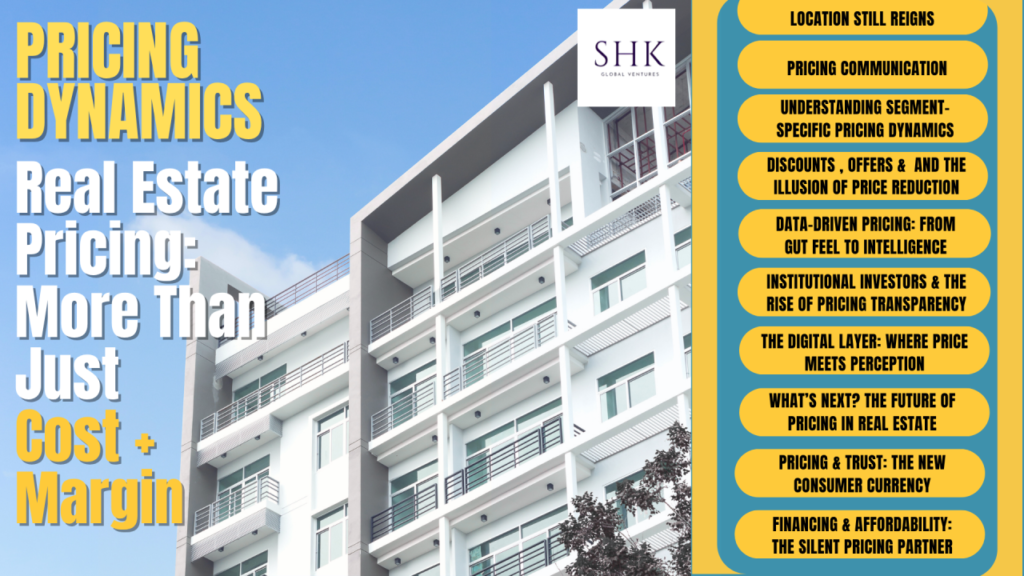
In a sector as dynamic and multi-layered as real estate, price isn’t just a number — it’s a reflection of value, a signal of intent, and often, a catalyst for transformation. Yet for all the talk about price per square foot, appreciation, and affordability, the mechanics of pricing in real estate remain opaque to many stakeholders.
As someone who has spent decades navigating the evolving intersections of real estate, finance, and investment strategy — I believe it’s time we rethink how we define, determine, and discuss pricing.
This post deep dives into:
- 🔍 The fundamentals behind pricing decisions
- 🧩 Key pricing drivers across asset classes
- 💼 Emerging influences in a tech-led, investor-focused era
- 🧠 Data intelligence, sentiment, and market psychology
- 🌐 What the future holds for pricing metrics
Let’s unpack the complexity — and opportunity — behind the numbers.
🏗️ 1. The Basics of Real Estate Pricing: More Than Just Cost + Margin
Real estate pricing traditionally follows a simple formula:
Land Cost + Construction Cost + Approvals + Marketing + Margin = Selling Price
But in reality, that’s just the starting point.
Today’s pricing strategy considers:
- Market demand and absorption capacity
- Brand premium and past project performance
- Competitive benchmarking
- Infrastructure and location development plans
- Policy-driven levers (stamp duty changes, taxation, etc.)
The moment you factor in buyer sentiment, regulatory volatility, and economic shifts, it becomes clear: pricing in real estate is as much an art as a science.
📍2. Location Still Reigns — But With Nuance
“Location, location, location” is a cliché for a reason. But we now look at location through multiple lenses:
- Micro-market vs. macro-market performance
- Social infrastructure: proximity to schools, malls, hospitals
- Workforce connectivity: metro access, highway reach, office clusters
- Future infrastructure: airports, coastal roads, metro lines
Interestingly, price appreciation often precedes physical transformation. The expectation of development is now baked into pricing strategies. Smart developers use this anticipatory premium to shape perception and drive early absorption.
🏙️ 3. Understanding Segment-Specific Pricing Dynamics
a) Residential Real Estate
- Affordable housing: Highly price-sensitive. Incentives, subsidies, and EMI structures heavily influence buying behavior.
- Mid-income housing: Driven by both aspiration and functionality. Amenities and quality often justify marginal premiums.
- Luxury and ultra-luxury: Emotion, exclusivity, brand, and location drive pricing. Scarcity becomes a core pricing tool.
b) Commercial Real Estate
- Office space pricing is governed by lease yield expectations, tenant profile, and future scalability.
- Grade-A buildings command a premium due to ESG compliance, tech-readiness, and maintenance standards.
c) Retail Spaces
- High footfall zones like high streets and malls witness dynamic pricing based on visibility, frontage, anchor tenant strength, and co-tenancy value.
d) Industrial and Warehousing
- Pricing is yield-driven, with significant weight given to location (NH connectivity, proximity to city hubs), storage height, and operational costs (labor, utilities).
📊 4. Data-Driven Pricing: From Gut Feel to Intelligence
The biggest shift in pricing strategy is the role of data intelligence.
Developers today have access to:
- Transaction data from RERA and government registries
- AI-powered pricing tools benchmarking local sales
- Digital footfall and clickstream behavior on real estate portals
- CRM insights on buyer profiles, preferences, and conversion timelines
This allows for micro-pricing strategies — different rates for units within the same building based on view, floor, Vastu, etc.
We’re also seeing dynamic pricing models, where rates change based on:
- Phase of launch (pre-launch vs. ready-to-move)
- Absorption velocity
- Inventory pressure
- Sales cycle targets
Pricing is no longer static. It’s responsive, reactive, and increasingly real-time.
💰 5. Financing & Affordability: The Silent Pricing Partner
You can’t talk about real estate pricing without discussing the buyer’s access to finance.
- EMI-to-income ratio is a major affordability benchmark.
- Interest rate cycles directly impact buyer sentiment and willingness to stretch budgets.
- Developers now collaborate with NBFCs, banks, and fintechs to create:
These financial innovations shape how pricing is communicated and perceived — even when the base price remains unchanged.
📉 6. Discounts, Offers, and the Illusion of Price Reduction
Let’s be honest: actual prices rarely fall. But perceived prices do — thanks to:
- Free parking
- No floor rise charges
- Stamp duty waivers
- Furnishing vouchers
- Buy-back assurances
Such tactics create an emotional pricing lever that keeps headline rates stable while improving affordability optics.
💼 7. Institutional Investors & the Rise of Pricing Transparency
The entry of REITs, SM REITs, family offices, and global funds into Indian real estate has raised the bar for pricing credibility.
Institutional players expect:
- Clear valuation methodologies
- Audited sales data
- Yield-based price metrics
- Market comps and asset reports
This shift is compelling even traditional developers to adopt more transparent pricing frameworks — a win for both investors and end-users.
🤝 8. Pricing & Trust: The New Consumer Currency
More than ever before, buyers view pricing as a trust signal.
- Are your prices consistent across channels?
- Do you honor pre-launch commitments?
- Is your GST input credit reflected in base pricing?
- Are escalation clauses clearly disclosed?
In a post-RERA world, smart pricing is not just about selling faster — it’s about building long-term credibility.
🌐 9. The Digital Layer: Where Price Meets Perception
Digital platforms have changed how pricing is perceived and compared.
From 99acres to MagicBricks, from WhatsApp groups to Reddit threads — consumers are now:
- Price-checking projects in real time
- Sharing screenshots of offers and discounts
- Using drone videos and walkthroughs to assess value per sq.ft.
If your price doesn’t match your online reputation, you’re losing the deal before the site visit even happens.
📢 10. Pricing Communication: More Than Just Numbers
How pricing is framed, positioned, and marketed is crucial:
- ₹2.5 Cr sounds heavy. ₹2.49 Cr feels digestible.
- “EMIs starting at ₹49,000/month” works better than total cost.
- “Only 3 units left at this price” triggers urgency.
- “Price protection till possession” builds buyer confidence.
Smart developers invest in pricing psychology — turning price into a conversion tool.
🔮 11. What’s Next? The Future of Pricing in Real Estate
Real estate pricing in India is evolving from instinct-driven guesstimates to tech-enabled, trust-led, investor-aligned frameworks.
Here’s what we’re seeing on the horizon:
- Tokenization of real estate will allow for fractional ownership and unitized pricing
- Dynamic pricing platforms based on real-time inventory, demand heatmaps, and search trends
- Proptech-led valuation engines integrating drone scans, IoT inputs, and footfall analytics
- Community-based pricing where resident reviews and social media sentiment shape new launches
And above all — the emergence of pricing as a strategic tool for long-term brand building, not just a sales lever.
👤 Final Thoughts
In a crowded market, price remains the most powerful differentiator — but only when it reflects authenticity, intelligence, and value.
At SHK Global Ventures, we believe the future of pricing lies in:
- Combining data with empathy
- Matching transparency with agility
- And reimagining price not as a static tag — but as a dynamic story.
If you’re in real estate — whether as a developer, investor, advisor, or buyer — it’s time to ask not just what your price is, but what it stands for.
Let’s build smarter. Let’s price better. Let’s create value that lasts.
💬 I’d love to hear your thoughts. What pricing innovations or challenges are you seeing in your market? Drop them in the comments or DM me — let’s co-create a more transparent, tech-forward real estate ecosystem.
#RealEstate #PricingStrategy #PropertyMarket #IndiaRealEstate #SmartInvesting #SHKGlobalVentures #FractionalOwnership #PropTech #RERA #REITs #Tokenization #LuxuryRealEstate #AffordableHousing #PricingDynamics